
Our "Vibe" Societies
"Everything is horrendous", said Thomas Bernhard

The text was orginally written in German and translated by DeepL
I like Thomas Bernhard, but I cannot really agree with him on this one. Maybe it’s because I am now 58 years old and people at my age have usually climbed out of the valley of unhappiness that supposedly holds us captive from 34 to 53.
I recently read in DIE ZEIT that a professor with the lovely name Bernd Raffelhüschen, an expert in happiness research, recommends differentiating between the 4 Gs (Gesundheit = health, Geld = money, Gemeinschaft = community, and genetic disposition) and the 4 Ks (Klima = climate, Krieg = war, Katastrophen = catastrophes, and Krise = crisis). The former influence our sense of happiness more than the latter, but things can get mixed up. Or as my grandfather liked to say: “Teachers are all unhappy because they have too much time to think.”
I’m not a teacher, but the Ks get to me too: Ukraine, Sudan, Gaza, factory farming, national debt, the political fragmentation of the world, the situation of migrants and, of course, climate change. In the past, from my 30s to late 40s, it didn’t affect me as much, probably because I was more concerned with the Gs, especially making money. Now I’m even worried about who will be the next president of France after Macron.
And anyway, it’s all the media’s fault. At my home in Chicago, I mostly read a selection of Anglo-American publications, for example Bloomberg (a lot about financial markets, but politically liberal), the Wall Street Journal (more about financial markets, but politically ambivalent at best), the Financial Times (pleasantly moderate in expression, with a global perspective), and the Economist (British ordoliberal). I tend to skim the rest (New York Times, New Yorker, Atlantic), because some of the news is emotionally and intellectually too taxing for me. “It’s bad, but what can you do?” said the late Prince Schwarzenberg, of which his daughter Lila rather disapproved (in her movie “My Father, the Prince”, 2022). I empathize with the Prince.
I also subscribe to the print edition of DIE ZEIT, available here for 428 Euros a year and always two weeks late. If DIE ZEIT can be seen as a mirror of German society, people are not doing too well, and many of them for good reason. German industrial output has been falling since the middle of the last decade because Americans and Chinese are buying fewer of their products, unemployment is on the rise again, and the general feeling of happiness in Germany is stagnating below the level of 2013 - according to the SKL happiness atlas (a state-owned lottery company for which Prof. Raffelhüschen conducted a study). And politicians are stuck in arguments about what to do about it.
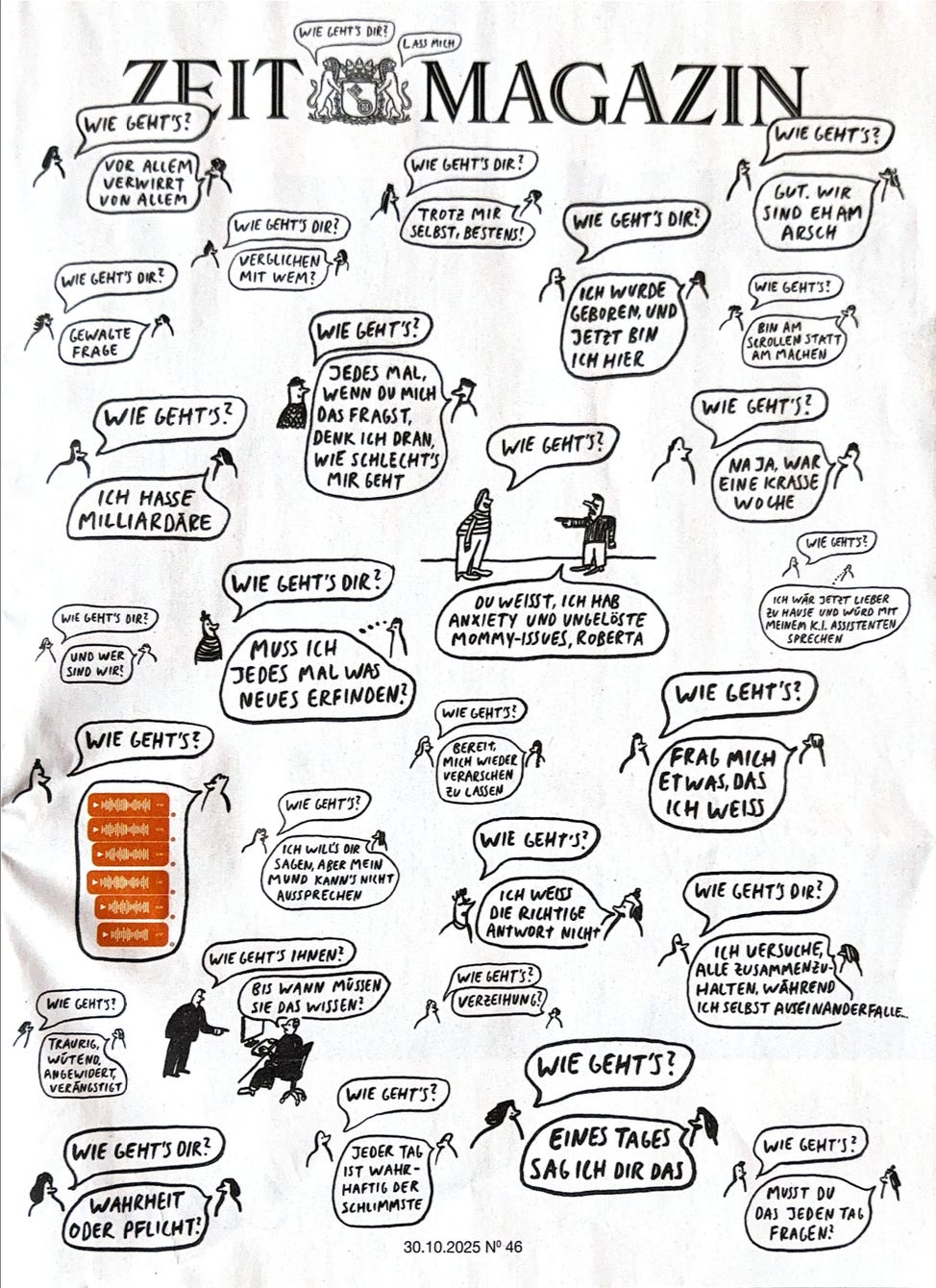
The question “How are you?” is not a common one in Germany, unlike in America, where everyone reflexively answers “Great!”, regardless of whether they have just been diagnosed with cancer or their parents died yesterday. Germans start ruminating quickly when asked about their wellbeing, which motivated DIE ZEIT to write a nice article:
Publications like DIE ZEIT or SPIEGEL naturally contribute a great deal to popular sentiment. Current editions include articles such as “Nowhere is there more lying than about pensions”, “Armed twelve-year-old girl critically injured in police operation” or “At first I thought I had dementia: every third woman feels that menopause affects her job”. Of course, things get worse when the BILD, Germany’s highest-circulation newspaper, fearfully murmurs: “Woman’s severed hands found on the A45 - the trail leads to a refugee home.”
In Germany as in America, and in all countries in general, people agree that the politicians are to blame for everything. And in Germany, especially Mrs. Merkel.
Even more desolate is Britain, where people have experienced nothing but disappointment since Tony Blair’s days, and even he can hardly venture out in public since his Iraq fiasco, while protected by bodyguards. No sooner is a new prime minister in power, like Keir Starmer whose party won 411 out of 600 seats in parliament last year, than he has to fear a coup by his benchers, front and back. Starmer’s unpopularity is only surpassed by Macron, who, according to YouGov, has a “net favorability rating” of minus 60, meaning that 80% of French people no longer like him and only 20% appreciate him. Almost none of the leaders of major democratic states can claim a positive Net Favorability Rating, not even the rather popular Giorgia Meloni who leads with minus 15. This has to be seen in comparison to the American president, who is not exactly uncontroversial on both sides of the Atlantic but has a rating of only minus 13, which is worse than that of his predecessor at the same time in office.
Real dictators like Putin, Xi or Erdogan have an easier time, first because they only worry about their popularity to a very limited extent, and second because even minor expressions of displeasure can quickly lead to irreversible consequences for the displeased.
The former Luxembourg Prime Minister and President of the European Commission Jean-Claude Juncker gets credited with the following insight: “We all know what to do, but we don’t know how to get re-elected once we have done it.” In a similar vein, the misery of Argentina’s politics and economy, which has over a century of history by now, can be explained by “overpromising politicians getting elected by an unrealistic public”. The country has tried every political system, from socialism to military dictatorship to anarcho-capitalism, and the suffering must have sufficed to give the troubled Milei an unexpected election victory.
At the moment, being a politician in affluent Western countries seems quite undesirable, at least not for people with a normal disposition. One gets the impression that it is only attractive to people with narcissistic tendencies or other neurotic disorders. That’s a pity, as most Western countries are doing quite well by historical standards and even Germany’s economic strength has returned to pre-pandemic levels (in GDP per capita terms) . Italy, on the other hand, had to go through a more protracted period of suffering since 2007, but it has recovered too now.
Although there are exceptions to the gloominess (e.g., Greece, Spain or Finland), most countries are currently experiencing a phase of pronounced dissatisfaction, especially with their economies. In such “vibe economies”, there is often a wide gap between perception and observable reality, especially in the USA:
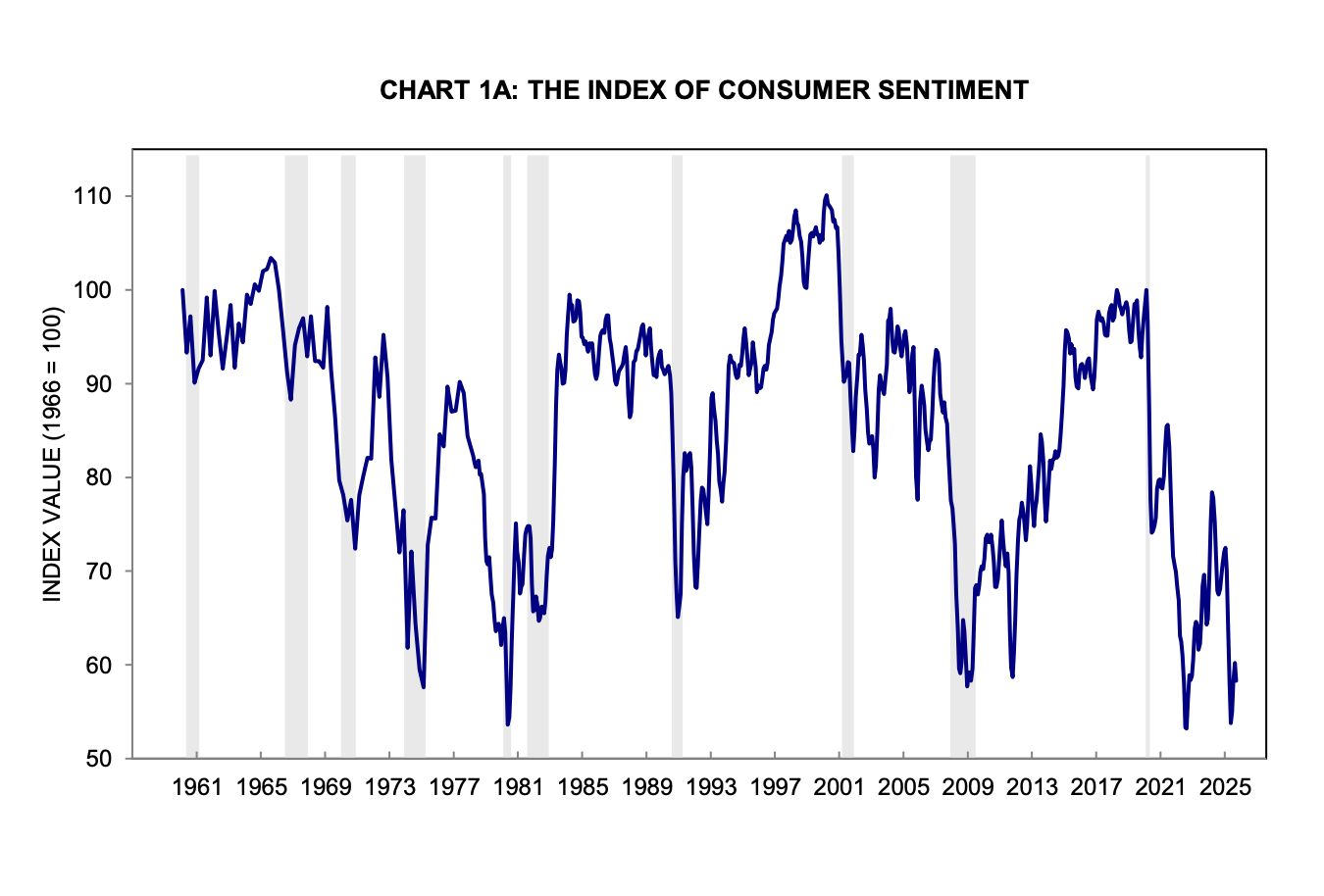
People here have never spent as much money per capita on consumption as today, with a 2% real increase (after inflation) per year since 2010, the end of the great financial crisis. But they feel as bad as they did in the 1970s, when the Vietnam War, Nixon, the oil crisis, runaway inflation and double-digit interest rates weighed on the country. Nobody has a good explanation for this, not even Paul Krugman, who has a Nobel Prize. Money and consumption obviously don’t make people happier.
Maybe the suffering has to increase, for people to realize that the government is not the solution to all problems. I have little hope for the outcome of the Gen Z revolutions, such as those taking place in Bangladesh, Indonesia, the Philippines, Kenya, Peru, Nepal, Madagascar, Morocco or New York City (Mamdani!). As understandable as their motives are and as similar as their global mottos are (”corruption is sus, stop ghosting democracy” - in Nepal!), the fullfilment of their wishes (”housing is a right for all”) and their participation in a transformation will hit some obstacles.
Personally, I believe that we need to learn more from the Finns. Finland is the country “where children play in the dark”, according to the writer Jukka Viikilä. There is a lot wrong here too, from rising national debt to high unemployment and economic stagnation in recent years. Nevertheless, people say they are happy with their lives and the country consistently ranks at the top of all satisfaction surveys. It must be due to the determination and resilience of the Finns in the face of extreme adversity. The concept is called “Sisu”.